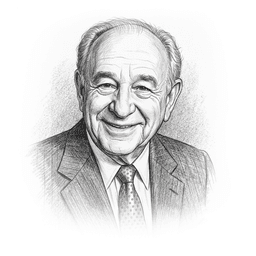
Sol Price
The little-known retailer who taught Sam Walton, Jim Sinegal, and Jeff Bezos everything they knew about building a business people trust.
New to Sol? Start with Sol Price: Retail Revolutionary and Social Innovator
Sol Price's Origin Story
Early Life
Sol Price was born January 23, 1916, in the Bronx to Samuel and Bella Price, Jewish immigrants from Minsk who'd each come through Ellis Island in 1904. The family moved to San Diego in the late 1920s after his father's tuberculosis diagnosis, and Sol turned out to be a genuine wunderkind — skipping two grades and graduating San Diego High School at just fifteen, all while being mischievous enough that a teacher warned his mother he'd end up either a gangster or a great success. He also carried a lifelong physical self-consciousness, a drooping eyelid since childhood, which by his own family's account made him shy and quietly fueled his drive to overachieve.
The Spark
After bouncing between colleges and finishing a philosophy degree and law degree at USC in 1938, Sol built a respected San Diego law practice for two decades. The real spark came in 1953, when his client and friend Mandell Weiss introduced him to the Fedco concept in Los Angeles — a members-only discount model for government employees — and Sol's mother-in-law happened to have a Main Street warehouse property to put behind it.
First Moves
Sol scraped together $50,000 (including $5,000 of his own money) and opened the first FedMart on Main Street in San Diego in December 1954, charging government employees a $2 lifetime membership. It wasn't a guaranteed hit, but it worked — FedMart grew into a regional chain across the Southwest, eventually dropping the membership requirement entirely in 1963 to open to the general public. FedMart became the blueprint that Walmart, Kmart, and Target all quietly borrowed from when they launched in 1962, though Sol himself wouldn't cash in on that legacy until it all fell apart under new German ownership two decades later.
Sol Price's Core Beliefs & Principles
Sol Price's Pivotal Decisions
Left law practice to open the first FedMart on Main Street in San Diego, seeded with just $50,000 (including $5,000 of his own money)
Created the discount/warehouse retail template — membership model, low margins, bulk packaging — that grew to nine stores and $300 million in revenue, and directly inspired Walmart, Kmart, and Target when they launched in 1962.
Eliminated FedMart's membership requirement, opening it to the general public
Massively expanded FedMart's customer base and accelerated its growth into Arizona, New Mexico, and Texas, cementing the discount retail format that competitors would later copy.
After being fired and locked out of FedMart by new majority owner Hugo Mann, immediately founded The Price Company and opened the first Price Club within months, investing $800,000 of his own money at age 60
Despite a near-fatal slow start (sales far below projections), the pivot to credit-union group memberships saved the business, which grew to nearly 100 stores and $8 billion in sales — pioneering the warehouse club model that became Costco and Sam's Club.
Merged Price Club with Costco to form PriceCostco
Consolidated the warehouse club industry's two dominant players into what became modern Costco, while Sol pivoted to found Price Enterprises/Price REIT and later PriceSmart, extending his retail model internationally.
Chose to openly share Price Club's operating model with visiting entrepreneurs like Sam Walton and Bernie Marcus rather than guard it competitively
Directly enabled the creation of Sam's Club and Home Depot, cementing his reputation as the foundational mentor of modern American retail — though it also helped rivals eventually overtake Price Club.
What NOT to Do
Sold control to the wrong partner
Sol sold a 64% stake in FedMart to German retailer Hugo Mann to fund expansion, only to be fired and locked out of his own company in 1975 on trumped-up mismanagement grounds. He won the lawsuit, but it cost him the business he built from scratch.
Price Club nearly died in its first weeks
Price Club launched with sales around $30,000/week against a projected $200,000/week, putting it on a path to bankruptcy. It only survived by pivoting to group memberships through a credit union partnership.
Took his eye off the core business
Sol diverted Price Club's capital and focus into real estate development instead of doubling down on retail operations, and shared extensive operational details with future rivals like Sam Walton. Both moves are credited with letting Costco and Sam's Club overtake Price Club despite its seven-year head start.
Sol Price Quotes
“Fortunately, we didn't know what wouldn't work or what we couldn't do.
“If you recognize you're really a fiduciary for the customer, you shouldn't make too much money.
“You train an animal, you teach a person.
“Our first duty is to our customers. Our second duty is to our employees. Our third duty is to our stockholders.
“Most everything I've done I've copied from somebody else.
Connections
Learned From
Introduced Sol to the Fedco retail concept during a 1953 visit to Los Angeles, which directly inspired the founding of FedMart — the origin point of Sol's entire retail career.
A client who taught Sol the value of business toughness in negotiations; Sol recalled the lesson with the line 'Well, that's okay if my wife wants to sink the ship. Let her sink the ship. I can swim better than she can.'
The German hypermarket owner Sol sold FedMart to; Sol observed and later adapted Mann's European 'passport membership' concept for business customers, which became the direct template for Price Club's membership model — even though Mann later fired Sol from FedMart.
Founder of E.J. Korvette discount stores who pioneered using membership requirements as a legal workaround to Fair Trade Laws — an idea Sol directly adapted for FedMart and later Price Club.
Sol's law mentor; when Weinberger left the firm to become San Diego's City Attorney in 1941, it created the opening for Sol to build his own independent client base, including future FedMart investors.
Influenced

Wholesale club concept and retail innovation - 'I learned more from Sol Price than any other individual' and 'I guess I've stolen as many ideas from Sol Price as anybody else in the business'
Sol Price's Life Timeline
Samuel Price and Bella Barkin separately immigrate to the U.S. through Ellis Island.
Samuel and Bella Price marry.
Sol Price born January 23 in the Bronx, New York City.
Sol's father Sam moves to San Diego alone after a tuberculosis diagnosis.
Rest of the family joins Sam in San Diego, buying a home in Burlingame.
Sol graduates San Diego High School at age fifteen.
Sol attends San Diego State College for a year.
Sol attends UCLA, experiences the Long Beach earthquake.
Sol's parents divorce.
Family moves near USC so Sol can finish his degree.
Sol elopes with Helen Moskowitz to Las Vegas; the marriage lasts 70 years.
Sol earns his undergraduate degree (philosophy) and Juris Doctor from USC, awarded Order of the Coif.
Sol admitted to the California State Bar.
Sol's mentor Jacob Weinberger serves as San Diego's City Attorney, later becoming a judge.
Sol opens his own law practice in partnership with Frank Nottbusch; the firm later evolves into Procopio, Cory, Hargreaves & Savitch LLP.
Sol's father-in-law Max Moskowitz dies.
Eugene Ferkauf opens the first E.J. Korvette discount store in New York, pioneering the membership loophole around Fair Trade Laws that Sol later adapts.
Tony Procopio joins as partner, forming Procopio, Price, Cory and Schwartz.
Sol's mother-in-law Bertha Moskowitz acquires the Main Street warehouse property; Sol visits Fedco in Los Angeles with client Mandell Weiss.
First FedMart opens on Main Street, San Diego, capitalized with $50,000, including $5,000 of Sol's own money.
FedMart's San Antonio store pays workers $1/hour versus competitors' 50 cents; Sol removes tables and chairs from a lunch counter to sidestep segregation law.
FedMart purchases property on Kearny Mesa for expansion.
Sam Walton visits the Houston FedMart and concludes warehouse retail is 'the wave of the future.'
FedMart opens its first pharmacy at the Main Street store; pharmacist Wayne Malloy receives death threats over price-cutting.
Walmart, Kmart, and Target open their first stores, each influenced by FedMart's model.
FedMart eliminates its membership requirement and opens to the general public.
Sol moves his office to the Fifth Avenue Financial Center; FedMart has nine stores open.
FedMart's flagship Sports Arena store opens in San Diego.
FedMart is sold in May to German retailer Hugo Mann's group; Sol is fired and locked out in December amid mismanagement allegations.
Sol wins his wrongful termination lawsuit against FedMart; founds The Price Company within a week of being fired; first Price Club opens in July on Morena Boulevard, San Diego.
Price Club posts its first profitable month in June after nearly failing.
Bernie Marcus visits Sol after being fired from Handy Dan Home Improvement; Sol advises him to build his own business instead of suing.
Bernie Marcus and Arthur Blank open the first Home Depot in Atlanta.
Price Club goes public.
Sam Walton visits Price Club to study the warehouse model; Sol and Helen Price found the Price Family Charitable Fund.
Sam Walton dines with Sol Price; the first Sam's Club opens in Oklahoma City; FedMart closes permanently.
Sol's 15-year-old grandson Aaron Price dies of a brain tumor; UCSD's Price Center opens April 21.
The Aaron Price Fellows Program is created in Aaron's memory.
The Price Company posts $134.1 million net income on $6.6 billion revenue, becoming San Diego County's largest public corporation.
Price Club merges with Costco to form PriceCostco; after eight months, Price Enterprises spins off under Robert Price's leadership.
Sol Price launches the City Heights revitalization initiative, eventually benefiting 74,000 residents.
Sol Price founds PriceSmart, extending warehouse clubs into Latin America and the Caribbean.
Senator Barack Obama visits Sol Price at his home in La Jolla.
Sol Price dies December 14 in San Diego at age 93.
The Price Family Charitable Fund donates $50 million to USC, renaming the school the USC Sol Price School of Public Policy.
The Aaron Price Fellows Foundation is established separately, led by Robert and Allison Price and their children.
Sol Price Net Worth Over Time
Values shown in estimated modern USD equivalents
Sol Price's Legacy & Impact
Business Impact
Sol Price invented the warehouse club retail model, first through FedMart and then Price Club, which directly shaped Costco, Sam's Club, and even influenced Walmart, Kmart, and Target's founding formats in 1962. His fiduciary, low-margin approach to retail rippled forward into Home Depot's founding and, decades later, into Amazon Prime's membership logic.
Philanthropy
- Price Family Charitable Fund / Price Philanthropies Foundation, continued by son Robert and Allison Price
- City Heights revitalization initiative in San Diego, funding education and community programs for over 74,000 residents
- City Heights Educational Collaborative, over $30 million invested
- Aaron Price Fellows Program, established 1991 in memory of his grandson, continues today via the Aaron Price Fellows Foundation (2018)
- UCSD Price Center, funded by a $2 million donation, opened 1989
- $50 million gift to USC, renaming its school the USC Sol Price School of Public Policy
- FedMart Foundation, awarded thousands of college scholarships over 20 years
Recognition
- Widely regarded as the 'father' of the warehouse store retail model
- USC Sol Price School of Public Policy named in his honor
- UCSD Price Center named in his honor
- Cited directly as a foundational influence by Sam Walton, Jim Sinegal, Bernie Marcus, and Charlie Munger
- Indirectly credited by Jeff Bezos and Trader Joe's founder as inspiration for their business models
Sources & Further Reading
- Wikipedia(website)
- The Knowledge Project(website)
- Investment Masters Class(website)
- San Diego History(website)
- Price Philanthropies(website)
- The San Diego Union Tribune(website)
- Founders Podcast - #304: Sol Price(podcast)
- Founders Podcast - #107 Sol Price(podcast)
- Founders Podcast - A conversation with David and Ben from the Acquired podcast(podcast)