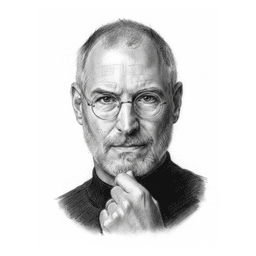
Steve Jobs
The visionary who turned technology into art and changed how we live, work, and connect.
New to Steve? Start with Steve Jobs by Walter Isaacson
Steve Jobs's Origin Story
Early Life
Growing up in Silicon Valley, Jobs learned craftsmanship from his adoptive father Paul, who taught him that "he knew how to build anything" and passed along "his love of mechanics." From an early age, Jobs "refused to accept automatically received truths and wanted to examine everything for himself" - a trait that would define his entire approach to business and life.
The Spark
The spark came in 1971 when Jobs and Wozniak read an Esquire article about phone freaking and hunted down the Bell System Technical Journal. Their blue box project taught them "how to work together and gave them confidence they could solve technical problems and put something into production."
First Moves
After working the night shift at Atari as an engineer in 1975, Jobs convinced Wozniak they could turn his computer design into a real business. On April 1, 1976, they founded Apple Computer Company in Jobs's parents' garage, with Jobs declaring "My vision was to create the first fully packaged computer" - complete integration from the start.
Steve Jobs's Core Beliefs & Principles
Steve Jobs's Pivotal Decisions
Founded Apple Computer Company with vision for fully packaged computers rather than just components for hobbyists
Transformed personal computing from niche hobby into mass market. Led to Apple II selling 6 million units over 16 years and established end-to-end integration philosophy that would define Apple's entire approach.
Bought Pixar's computer graphics division from Lucasfilm for $10 million after being ousted from Apple
Created parallel career path that proved his abilities beyond Apple. Pixar's eventual $7.4 billion sale to Disney made Jobs Disney's largest shareholder and validated his product vision in entirely different industry.
Returned to Apple as interim CEO, took $1 salary, and radically simplified product line to just 4 products in 2x2 grid
Saved Apple from 90-day insolvency, turning $1.04 billion loss into $309 million profit in one year. This focus strategy became foundation for iPhone, iPad, and Apple's rise to world's most valuable company.
Shelved iPad project to focus resources on iPhone because people would understand need for 'better phone' over tablet concept
iPhone revolutionized mobile industry and became Apple's primary revenue driver. Strategic sequencing allowed Apple to perfect multi-touch technology on phone before expanding to tablet, creating two dominant product categories instead of potentially failing at both.
What NOT to Do
Brutal early management style
Jobs regularly called employees 'B players' and 'dumb shits,' creating a toxic environment that drove away talent. He eventually learned to mentor privately, but his early approach was unnecessarily destructive.
NeXT strategic failures
Despite years of development, NeXT only sold 50,000 computers and Jobs killed a $60M IBM deal by overplaying his hand. His perfectionism and ego got in the way of practical business execution.
Inconsistent product judgment
The Lisa computer was a commercial flop at only 100,000 units sold, and MobileMe was such a disaster it had to be completely rebuilt as iCloud. Even visionaries swing and miss sometimes.
Steve Jobs Quotes
“If it hadn't been for the blue boxes, there wouldn't have been an Apple. I'm 100% sure of that
“A players like to work only with other A players, which means you can't indulge B players
“People don't know what they want until you show it to them
“The only way to do great work is to love what you do. If you haven't found it yet, keep looking, don't settle
“My passion has been to build an enduring company where people were motivated to make great products. Everything else was secondary
Connections
Learned From

Clarity about personal priorities — Grove's indifference to Apple made Jobs realize 'I do give a shit about Apple'

Edwin Land had a profound impact on Steve Jobs, inspiring him with his relentless focus on innovation, design elegance, and creating products that delight users. Jobs often cited Land’s vision and perfectionism at Polaroid as a model for building transformative technology and shaping his own business philosophy.

Urgency and aggressive timelines in business — learned to set schedules in days and weeks rather than months

Company building and legacy thinking — studied how to build enduring companies and leave money to foundations
Craftsmanship and attention to detail — learned that quality extends to parts others can't see, and the importance of building things with your hands
Technical collaboration and problem-solving — the blue box project taught them how to work together and gave confidence they could solve technical problems
Public speaking and communication skills — transformed into an extraordinary extemporaneous speaker who could wield that tool to great effect
Operational excellence and company building principles from Intel's co-founder
Patience and private mentoring — learned one-on-one mentoring and how to work with creative people over time
Hiring methodology — studied the type of people Oppenheimer sought for the atom bomb project as a model for building teams
Influenced

Extreme focus, product quality, and the ability to attract top talent.
Steve Jobs's Life Timeline
Jobs and Wozniak read Esquire article about phone freaking, found Bell System Technical Journal and began their blue box project.
Jobs worked night shift at Atari as engineer, learning urgency and business approach from Nolan Bushnell.
Apple Computer Company founded April 1 in Jobs's parents' garage with vision to create first fully packaged computer.
Apple II introduced at West Coast Computer Faire, launching what would become Apple's first major commercial success.
Apple went public December 12 at $22 per share, making 25-year-old Jobs worth $256 million overnight.
Macintosh introduced January 24, popularizing graphical user interfaces but selling only 100,000 units as the Lisa.
Jobs resigned from Apple September 17 after being pushed out, immediately founding NeXT with $7 million in initial funding.
Jobs bought Pixar computer graphics division from Lucasfilm for $10 million ($5M to company, $5M to Lucasfilm).
Toy Story released as Pixar's first film, earning $361 million worldwide box office receipts and proving animation's digital future.
Apple acquired NeXT for $400 million and Jobs returned as interim CEO when Apple was less than 90 days from insolvency.
iMac introduced and Apple online store launched, turning $1.04 billion loss into $309 million profit in Jobs's first full fiscal year.
iPod released October 23 at $399, beginning Apple's transformation from computer company to consumer electronics powerhouse.
Disney acquired Pixar for $7.4 billion, making Jobs Disney's largest shareholder with 7% stake.
iPhone released June 29, turning mobile phones into multimedia devices and spawning the app economy.
iPad released April 3, launching the tablet computing era with a device originally conceived before the iPhone.
Jobs died October 5, leaving Apple as the most valuable company on Earth and having transformed multiple industries.
Steve Jobs Net Worth Over Time
Values shown in estimated modern USD equivalents
Steve Jobs's Legacy & Impact
Business Impact
Jobs transformed entire industries across three decades, launching the personal computer revolution with Apple II, revolutionizing mobile phones with iPhone, and creating the tablet computing category with iPad. He built Apple into the most valuable company on Earth while simultaneously nurturing digital imagination through Pixar blockbusters and spawning the app economy that redefined content creation.
Sources & Further Reading
- Founders Podcast - #5 Steve Jobs(podcast)
- Founders Podcast - #19 Becoming Steve Jobs(podcast)
- Founders Podcast - #76 Steve Jobs: The Early Years of Apple(podcast)
- Britannica(website)
- Wikipedia(website)