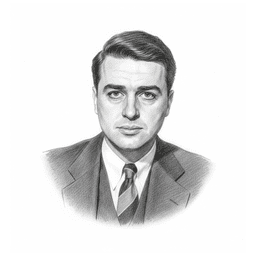
Edwin Land
The brilliant scientist and founder who turned imagination into instant reality and redefined how the world captures its most meaningful moments
New to Edwin? Start with A Triumph of Genius: Edwin Land, Polaroid, and the Kodak Patent War
Edwin Land's Origin Story
Early Life
Edwin Land was born May 7, 1909, in Bridgeport, Connecticut, to Harry Land, a Ukrainian Jewish scrap metal dealer from a village near Kyiv, and Matie Goldfaden. His sister Helen nicknamed him 'Din,' and he graduated with honors from Norwich Free Academy in 1927. That fall, he entered Harvard as a freshman but would soon discover that formal education couldn't contain his curiosity.
The Spark
Land became obsessed with polarizing light after reading physicist Robert Wood's 1911 book on polarization—he read it nightly and literally slept with it under his pillow. When Harvard's lab hours couldn't satisfy his experimental hunger, he started sneaking into Columbia University's physics lab at night to conduct his own research.
First Moves
After dropping out of Harvard following his freshman year, Land filed his first patent for a sheet polarizer on April 26, 1929. In 1932, he founded Land-Wheelwright Laboratories with Harvard physics professor George Wheelwright III, who provided both scientific credibility and crucial funding. The company was renamed Polaroid Corporation in 1937, setting the stage for Land's transformation from college dropout to one of America's most prolific inventors.
Edwin Land's Core Beliefs & Principles
Edwin Land's Pivotal Decisions
Dropped out of Harvard after freshman year to pursue polarization research, sneaking into Columbia University labs at night to conduct experiments
This bold move allowed him to focus entirely on developing his sheet polarizer invention, leading to his first patent in 1929 and the foundation of his entire career. Without this decision, edwin land would never have had the concentrated time needed to solve the polarization problem that everyone else had failed to crack.
Founded Land-Wheelwright Laboratories with George Wheelwright III instead of licensing his polarizer technology to existing companies
This decision gave him control over his inventions and their applications. It established the foundation for what would become Polaroid Corporation in 1937, allowing him to build a company culture around scientific research and maintain ownership of the full product experience.
Pivoted from polarization technology to instant photography after his daughter asked why she couldn't see a photo immediately after it was taken
This moment in Santa Fe fundamentally changed his career trajectory and created an entirely new industry. The edwin land polaroid camera, launched in 1948, became the company's defining product and made him a household name. It demonstrated his ability to solve 'manifestly important and nearly impossible' problems.
Learned from failed automotive partnerships and decided to sell directly to consumers rather than as a supplier to other manufacturers
After Detroit refused to adopt his polarized headlight system, edwin land realized he needed direct consumer control. This belief in controlling the entire system became core to Polaroid's strategy and influenced how he launched the instant camera - creating dramatic public demonstrations and building consumer demand rather than relying on industry adoption.
Bet the company on Polavision instant movies despite market research showing limited consumer interest
This decision ultimately ended his tenure at Polaroid. The soundless 3-minute movies were too late to market and cost hundreds of millions in write-downs. It showed the limits of his philosophy that 'marketing is what you do if your product is no good' - sometimes even brilliant inventors need to listen to market signals.
What NOT to Do
Missed the digital revolution
Land's obsession with chemical processes and analog perfection blinded him to the coming digital shift. Polavision was a spectacular $68 million write-down that helped push him out of his own company.
Refused to work within existing systems
His failure to convince Detroit automakers to adopt polarized headlights shows how his all-or-nothing approach sometimes prevented beneficial partnerships that could have saved lives.
Created a company too dependent on his genius
Despite hiring brilliant people, Polaroid became Ralph Waldo Emerson's definition of an institution: 'the lengthened shadow of one man.' When Land left, the shadow disappeared.
Edwin Land Quotes
“If anything is worth doing, it's worth doing to excess
“Don't do anything that someone else can do
“My whole life has been spent trying to teach people that intense concentration for hour after hour can bring out in people resources they didn't know they had
“Marketing is what you do if your product is no good
“The bottom line is in heaven
Connections
Learned From

The power of practical invention and patent accumulation - Land explicitly compared his patent count to Edison's and shared Edison's belief in creating commercially viable applications from scientific discoveries

Hiring and personally training untrained talent rather than relying on established experts - Land adopted Ford's approach of bringing in fresh minds and molding them to his methods
Foundational scientific knowledge through deep study - Land read Wood's 1911 book on polarization nightly and slept with it under his pillow, providing the theoretical foundation for his polarizing filter invention
How to introduce revolutionary technology to skeptical markets - Land drew inspiration from Bell's telephone introduction when crafting his instant camera marketing approach
Influenced

Edwin Land had a profound impact on Steve Jobs, inspiring him with his relentless focus on innovation, design elegance, and creating products that delight users. Jobs often cited Land’s vision and perfectionism at Polaroid as a model for building transformative technology and shaping his own business philosophy.
Edwin Land's Life Timeline
Born May 7 in Bridgeport, Connecticut to Harry Land and Matie Goldfaden.
Entered Harvard as a freshman but became frustrated with formal education constraints.
Graduated Norwich Free Academy with honors before starting college.
Filed first patent for sheet polarizer on April 26 after dropping out of Harvard.
Founded Land-Wheelwright Laboratories with Harvard physics professor George Wheelwright III.
Renamed company to Polaroid Corporation, establishing the brand that would make him famous.
Co-founder George Wheelwright III left the company, giving Land full control.
Got the idea for instant photography while walking with daughter Jennifer in Santa Fe when she asked why she couldn't see a photo immediately after he took it.
Demonstrated the first instant camera to the Optical Society of America on February 21, stunning the scientific community.
The Polaroid camera went on sale to the public, with all 57 cameras selling out on the first day at Jordan Marsh department store.
Harvard awarded him an honorary doctorate, recognizing the dropout who had revolutionized photography.
Resigned as advisor to President Nixon during the Watergate scandal, later ending up on Nixon's enemies list.
Resigned as Chairman of Polaroid Corporation on July 27 after the Polavision failure.
Edwin Land died March 1 at age 81 in Cambridge, Massachusetts, leaving behind 535 patents and a transformed industry.
Edwin Land's Legacy & Impact
Business Impact
Land created the entire instant photography industry and demonstrated the power of controlling the complete product experience from camera to film. His approach to dramatic product demonstrations, hiring practices that valued breadth plus depth, and philosophy of scientific daring with financial conservatism directly influenced Steve Jobs and modern tech company culture.
Philanthropy
- Rowland Institute for Science (founded in retirement)
- Led affirmative action efforts after MLK assassination
Recognition
- Honorary doctorate from Harvard (1957)
- Third-highest patent holder in U.S. history with 535 patents
- Called 'national treasure' by Steve Jobs
Sources & Further Reading
- Wikipedia(website)
- Britannica(website)
- Founders Podcast - #40 Insisting on the Impossible(podcast)
- Founders Podcast - #132 Edwin Land (Steve Jobs's Hero)(podcast)
- Founders Podcast - #133 Edwin Land (Polaroid and The Man Who Invented It)(podcast)
- Founders Podcast - #264 The Story of Edwin Land and Polaroid(podcast)
- Founders Podcast - Steve Jobs and Edwin Land(podcast)