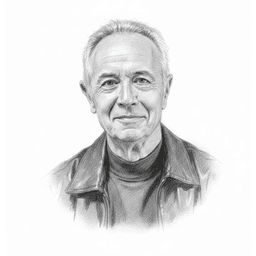
Andy Grove
The Hungarian refugee who built Intel into the world's most dominant chipmaker and pioneered modern management.
New to Andy? Start with Swimming Across: A Memoir
Andy Grove's Origin Story
Early Life
Born Gróf András István in Budapest in 1936, Andy Grove's childhood was a masterclass in survival. At age 4, scarlet fever left him partially deaf. By age 20, he'd lived through Nazi occupation (his Jewish family survived by taking false identities), Soviet siege, and multiple Communist regimes while watching his father get arrested and tortured in an Eastern Labor Camp.
The Spark
The 1956 Hungarian Revolution gave Grove his chance. When 200,000 Hungarians escaped to the West, he was among them—heading toward the lights of Austria with nothing but determination.
First Moves
Arriving in America penniless and barely speaking English, Grove worked as a busboy at a Catskill resort where he met his future wife Eva, a waitress. He threw himself into education, earning his bachelor's from City College of New York in 1960 and a PhD in chemical engineering from UC Berkeley by 1963.
Andy Grove's Core Beliefs & Principles
Andy Grove's Pivotal Decisions
Escaped Hungary during the revolution at age 20, fleeing to Austria and then America
This literally made everything else possible. Grove left behind his entire life, arriving in the US penniless and barely speaking English. Without this courageous leap, there would be no Intel story - just another brilliant engineer trapped behind the Iron Curtain.
Left secure position at Fairchild to become Intel's third employee on incorporation day
Grove himself said he was 'scared to death' leaving his secure role for an 'untried venture.' This decision positioned him to eventually become CEO and transform Intel into the world's largest semiconductor company - turning a $2,672 first-year revenue startup into a $197 billion market cap giant.
Led Intel's exit from the memory chip business to focus entirely on microprocessors
This was Intel's ultimate strategic inflection point. Grove helped pivot the company from being just another memory manufacturer to becoming the dominant force in microprocessors - the brains of the personal computer revolution. This decision created Intel's monopoly-like position in PC chips and made the company central to the global information economy.
Developed and implemented the OKR (Objectives and Key Results) management system at Intel
This management innovation became Grove's most influential legacy beyond Intel itself. OKRs later helped Google achieve '10x growth multiple times' according to Larry Page, and spread throughout Silicon Valley. Grove essentially created the goal-setting framework that powered much of tech's explosive growth.
What NOT to Do
Work-Life Balance Destruction
Despite building one of the world's most successful companies, Grove's personal life imploded with deep depression, divorce, and strained relationships with his children. Success at Intel came at a devastating personal cost that he never fully resolved.
Pentium Crisis Mismanagement
When Intel's Pentium chip had a floating-point defect, Grove's initial response created a massive PR disaster. His engineering mindset led him to downplay a problem that customers cared deeply about, nearly destroying Intel's consumer credibility.
Inability to Fire Poor Performers
Despite his reputation for tough management, Grove struggled to fire underperforming employees because he wanted to be loved. This weakness forced him to rely on others to do the 'dirty work' of personnel decisions.
Andy Grove Quotes
“Business success contains the seeds of its own destruction. Success breeds complacency. Complacency breeds failure. Only the paranoid survive.
“A corporation is a living organism; it has to continue to shed its skin. Methods have to change. Focus has to change. Values have to change. The sum total of those changes is transformation.
“The key result has to be measurable. But at the end you can look, and without any arguments: Did I do that or did I not do it? Yes? No? Simple. No judgments in it.
“I couldn't afford luxuries like embarrassment.
“Life is like a big lake. All the boys get in the water at one end and start swimming. Not all of them will swim across. But one of them I sure will. And that is Grove.
Connections
Learned From

Intel co-founder and inventor of the integrated circuit who served as Grove's direct mentor, teaching him both technical innovation and business leadership at the highest levels

Co-founder of Intel who created Moore's Law predicting semiconductor performance doubling, providing the strategic framework for Intel's long-term technology roadmap
Influenced

Clarity about personal priorities — Grove's indifference to Apple made Jobs realize 'I do give a shit about Apple'
Andy Grove's Life Timeline
Born in Budapest, Hungary
Contracted scarlet fever at age 4, causing partial hearing loss
Father conscripted to labor battalion for Russian front
Germans occupied Hungary and implemented the Final Solution
Soviet army liberated Budapest, father returned
Communist Party consolidated power in Hungary
Hungarian Revolution began in October
Escaped to Austria, then arrived in United States penniless
Married Eva Kastan in June in Roman Catholic ceremony
Graduated with bachelor's degree in chemical engineering from City College
Earned PhD from UC Berkeley, started at Fairchild Semiconductor as researcher
Became assistant director of development at Fairchild, wrote first book
Intel incorporated, Grove joined as third employee on day of incorporation
Intel introduced world's first microprocessor
Intel developed 8080 processor for Altair PC
Intel unveiled 8088 microchip that would be chosen by IBM
Appointed Intel president
Published High Output Management
Intel produced 80386 microprocessor and exited memory business
Became Intel CEO
Published Only the Paranoid Survive
Named Time Person of the Year and became Intel chairman
Stepped down as CEO, succeeded by Craig Barrett
Diagnosed with Parkinson's disease
Stepped down as Intel chairman
Made $26 million donation to City College of New York
Died March 21 at age 79
Andy Grove's Legacy & Impact
Business Impact
Grove transformed Intel from a $4 billion memory chip company into a $197 billion microprocessor giant, establishing it as the central company in the global information economy. He pioneered management methodologies like OKRs and constructive confrontation that became standard practices across Silicon Valley, while mentoring leaders like Steve Jobs and influencing a generation of tech executives.
Philanthropy
- International Rescue Committee
- City College of New York engineering education
Recognition
- Time Magazine Person of the Year 1997
Sources & Further Reading
- Wikipedia(website)
- Harvard Business School(website)
- Britannica(website)
- Forbes(website)
- Founders Podcast - #8 The Intel Trinity(podcast)
- Founders Podcast - #159 Andy Grove (Intel)(podcast)