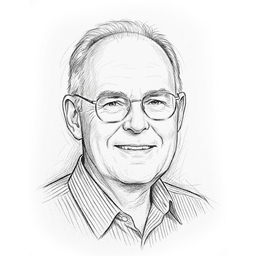
Gordon Moore
The quiet revolutionary who predicted the future and built Intel into a semiconductor empire.
New to Gordon? Start with The Intel Trinity: How Robert Noyce, Gordon Moore, and Andy Grove Built the World's Most Important Company
Gordon Moore's Origin Story
Early Life
Gordon Moore grew up as the son of a San Mateo County sheriff and homemaker in Depression-era California. When the family moved to Redwood City in 1938 after his father's promotion to deputy sheriff, young Gordon was already showing signs of the introverted personality that teachers noted when he started school. The pivotal moment came in 1940 when he received a chemistry set for Christmas — a gift that would literally change the world.
The Spark
That chemistry set ignited Moore's fascination with how things work at the molecular level. By the time he reached Sequoia High School, he knew he wanted to be a chemist, setting him on a path that would eventually lead from atoms to transistors to the digital revolution.
First Moves
After graduating UC Berkeley with a chemistry degree in 1950 (the same year he married his college sweetheart Betty), Moore headed to Caltech for his PhD. His early career took him through postdoctoral research at Johns Hopkins, then to William Shockley's semiconductor lab in 1956. But when Shockley proved impossible to work with, Moore joined the famous 'traitorous eight' who left to form Fairchild Semiconductor — his first real taste of Silicon Valley entrepreneurship.
Gordon Moore's Core Beliefs & Principles
Gordon Moore's Pivotal Decisions
Left William Shockley with the 'traitorous eight' to form Fairchild Semiconductor
This defection from the Nobel Prize winner who recruited him launched the Silicon Valley startup culture and gave Moore his first taste of building semiconductor companies from scratch.
Published prediction that transistor density would double annually for the next decade
Moore's Law became the semiconductor industry's north star, driving decades of exponential progress and making possible everything from Apollo missions to personal computers.
Left Fairchild with Robert Noyce to found Intel Corporation
Created the world's largest semiconductor company, growing from $3,000 in first-year sales to $633 million by 1979. Intel's microprocessor invention under Moore's leadership sparked the personal computer revolution.
Implemented radical flat management structure and gave all employees stock options from Intel's founding
This egalitarian approach - working from a scratched desk while giving employees better furniture - became the Silicon Valley management template and created massive wealth for Intel's workforce.
Established the Gordon and Betty Moore Foundation with a $5 billion gift
One of the largest philanthropic commitments in history, focusing on environmental conservation and scientific research. Total giving exceeded $7 billion, including the largest higher education gift ever at the time ($600M to Caltech).
What NOT to Do
Family sacrifice for success
Moore's intense focus on building Intel came at a personal cost - his divorce impacted his children, with both struggling with drugs and one being hospitalized for bipolar disorder. Even brilliant founders can lose sight of what matters most at home.
Technical perfectionism without business sense
Early in his career, Moore designed a platinum furnace element that burned out after just two weeks, requiring expensive recovery of thousands of dollars worth of platinum. Smart engineers sometimes overcomplicate solutions when simpler approaches work better.
Gordon Moore Quotes
“Average players want to be left alone. Good players really want to be coached and great players want to be told the truth.
“If everything you try works, you aren't trying hard enough.
“Most of what I learned as an entrepreneur was by trial and error.
Connections
Learned From
First exposure to transistor technology and solid state electronics - Gale was physics professor at Grinnell College who obtained the first transistors and provided Moore's first academic instruction in solid state electronics
Direct mentorship in semiconductor physics and transistor development - Nobel Prize winner who recruited Moore to Shockley Semiconductor Laboratory in 1956, giving him foundational experience in the semiconductor industry
Influenced

Co-founder of Intel who created Moore's Law predicting semiconductor performance doubling, providing the strategic framework for Intel's long-term technology roadmap
Gordon Moore's Life Timeline
Gordon Moore born January 3 in San Francisco as second son of sheriff Walter Moore and homemaker Florence Williamson.
Started school, with faculty noting his introverted personality.
Family moved to Redwood City when father accepted promotion to deputy sheriff.
Received chemistry set as Christmas gift, sparking lifelong interest in chemistry.
Studied at Sequoia High School, participating in athletic activities.
Attended San José State College studying chemistry.
Met future wife Betty Irene Whitaker during student government conference at Asilomar.
Transferred to University of California, Berkeley.
Graduated UC Berkeley with Bachelor of Science in chemistry and married Betty.
Studied at California Institute of Technology for PhD.
Conducted postdoctoral research at Applied Physics Laboratory at Johns Hopkins University.
Received PhD in chemistry from Caltech and son Kenneth born.
Joined William Shockley at Shockley Semiconductor Laboratory.
Left with the 'traitorous eight' when Sherman Fairchild backed them to create Fairchild Semiconductor.
Became director of research and development at Fairchild and son Steven born.
Published Moore's Law prediction in Electronics Magazine on April 19, forecasting doubling of components every year for next decade.
Co-founded Intel Corporation with Robert Noyce in July, initially called NM Electronics.
Intel reached $4.2 million in annual revenues.
Intel achieved $23 million in sales with 1,000 employees in fourth year.
Intel sales reached $66 million with 2,500 employees in fifth year.
Became Intel president and revised Moore's Law prediction to approximately every two years.
Elected member of National Academy of Engineering.
Became Intel chairman and CEO in April as company reached $633 million in revenues.
Intel annual sales reached $1 billion and Moore became member of Caltech board of trustees.
Stepped down as Intel CEO but remained chairman.
Received National Medal of Technology and Innovation from President George H.W. Bush.
Served as chairman of Caltech board of trustees.
Named Intel chairman emeritus.
Established Gordon and Betty Moore Foundation with $5 billion gift.
Donated $600 million to Caltech, largest gift to higher education at the time.
Received Presidential Medal of Freedom from President George W. Bush.
Donated $200 million with wife for Thirty Meter Telescope construction.
Received IEEE Medal of Honor.
Inducted into National Inventors Hall of Fame and received Andrew Carnegie Medal of Philanthropy.
First human genome sequenced on Ion Torrent's Personal Genome Machine platform.
Intel renamed Oregon campus 'Gordon Moore Park' and building 'Moore Center' in his honor.
Died March 24 at home in Waimea, Hawaii at age 94, with net worth reported as $7 billion.
Gordon Moore Net Worth Over Time
Values shown in estimated modern USD equivalents
Gordon Moore's Legacy & Impact
Business Impact
Moore co-founded Intel and formulated Moore's Law, the cornerstone principle that drove exponential technological progress for decades. His flat management philosophy, employee stock options, and vendor partnership strategies became the Silicon Valley playbook that inspired entrepreneurs like Steve Jobs.
Philanthropy
- Gordon and Betty Moore Foundation ($5 billion endowment)
- Environmental conservation
- Scientific research funding
- $600 million to Caltech
- $200 million for Thirty Meter Telescope
Recognition
- Presidential Medal of Freedom (2002)
- National Medal of Technology and Innovation (1990)
- IEEE Medal of Honor (2008)
- National Inventors Hall of Fame (2009)
- National Academy of Engineering member (1976)
Sources & Further Reading
- Wikipedia(website)
- Britannica(website)
- National Inventors Hall of Fame(website)
- Science History(website)
- PBS(website)
- EBSCO(website)
- Gordon & Betty Moore Foundation(website)
- Computer History(website)
- Founders Podcast - #8 The Intel Trinity: How Robert Noyce, Gordon Moore, and Andy Grove Built the World's Most Important Company(podcast)
- Founders Podcast - #356 How The Sun Rose On Silicon Valley: Bob Noyce (Founder of Intel)(podcast)
- Founders Podcast - #166 Robert Noyce (Intel)(podcast)
- Oral History of Gordon Moore(video)