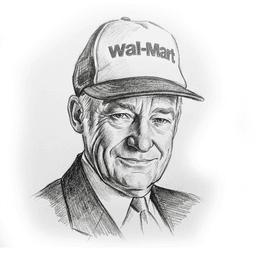
Sam Walton
The small-town farm boy who built the world's largest corporation by putting customers first and copying every good idea he could find.
New to Sam? Start with Sam Walton: Made In America by Sam Walton & John Huey
Sam Walton's Origin Story
Early Life
Born in 1918 in Kingfisher, Oklahoma, Sam Walton moved frequently during childhood as his father Thomas worked in farm mortgaging during the Great Depression. The constant moves taught him adaptability, while his father's work ethic philosophy—'The secret is work, work, work'—became foundational. He channeled his competitive drive into becoming Missouri's youngest Eagle Scout in eighth grade and being voted 'Most Versatile Boy' in high school.
The Spark
After graduating University of Missouri with an economics degree in 1940, Sam joined JCPenney as a management trainee for $75 a month. A Sunday meeting with store manager Duncan Majors and a personal encounter with founder J.C. Penney himself—who taught him 'we don't make a dime out of the merchandise we sell, we only make our profit out of the paper and string we save'—planted the retail seed.
First Moves
In 1945, fresh out of military service, Sam borrowed $20,000 and used $5,000 in savings to buy his first Ben Franklin variety store in Newport, Arkansas. He grew sales from $80,000 to $225,000 in three years through relentless experimentation and cost control. But he learned a brutal lesson about lease agreements—when his landlord refused to renew in 1950, wanting the successful store for a family member, Sam lost everything and had to start over in Bentonville.
Sam Walton's Core Beliefs & Principles
Sam Walton's Pivotal Decisions
Opened first Walmart in Rogers, Arkansas targeting small towns that competitors ignored
Pioneered the small-town discount retail strategy that became Walmart's foundation. While competitors focused on cities, Sam discovered 'there was much, much more business out there in small town America than anybody, including me, had ever dreamed of.' This contrarian approach allowed Walmart to dominate untapped markets and grow from $1 million in first-year sales to eventually becoming the world's largest corporation by revenue.
Created family partnership giving children equal ownership stakes in the business
This single decision secured the Walton family's long-term wealth and control. By structuring ownership early when the business was small, Sam ensured his children would benefit from all future growth. The family partnership became the foundation for what is now a $440+ billion family fortune, making them the richest family in America for decades.
After losing the Newport store lease, chose to start over in tiny Bentonville, Arkansas rather than move to a bigger city
Losing Newport was devastating - Sam had built sales from $80,000 to $225,000 in three years. But choosing Bentonville (population 3,000) over a larger market proved brilliant. It became Walmart's permanent headquarters, keeping costs low and maintaining the small-town culture that defined the company. As Sam said: 'I'm not whipped. I found Newport and I found the store. I can find another good town and another store.'
Founded Sam's Wholesale Club after learning from Sol Price's warehouse concept
This decision created Walmart's second major revenue stream and competitive moat. Sam admitted 'I learned more from Sol Price than any other individual' and adapted the wholesale club model. By his death, there were 212 Sam's Clubs contributing significantly to Walmart's $50 billion in annual sales, proving his ability to spot and scale winning retail concepts beyond traditional discount stores.
What NOT to Do
Catastrophic lease oversight
Lost his successful Newport Ben Franklin store after 5 years because he failed to include a renewal clause in his lease - a basic business mistake that cost him a thriving $225,000 annual revenue business when his landlord wanted to give the store to a family member.
Failed retirement and management chaos
Tried to retire in 1974 but couldn't stay away, creating company division and causing management exodus when he returned and undermined his chosen successor - proving he was unable to truly delegate or step back from day-to-day operations.
Early exploitation of workers
Initially paid workers only 50 cents per hour and admitted he was 'so doggone competitive and so determined that I was blinded to the most basic truth' about taking care of employees - showing his obsession with winning sometimes overrode basic fairness.
Shopping center development distraction
In the 1950s, Sam took a costly detour from his successful variety store chain to develop shopping centers, losing money and wasting valuable time on something outside his core competency
Sam Walton Quotes
“There's absolutely no limit to what plain, ordinary working people can accomplish if they're given the opportunity and the encouragement and the incentive to do their best
“Most everything I've done, I've copied from somebody else
“If you want the people in the stores to take care of the customers, you have to make sure you're taking care of the people in the stores
“Our money was made by controlling expenses. Every time Walmart spends $1 foolishly, it comes right out of our customers' pockets
“You can learn from everybody
“You can make a lot of different mistakes and still recover if you run an efficient operation. Or you can be brilliant and still go out of business if you're too inefficient
Connections
Learned From

Wholesale club concept and retail innovation - 'I learned more from Sol Price than any other individual' and 'I guess I've stolen as many ideas from Sol Price as anybody else in the business'
Work ethic fundamentals - 'The secret is work, work, work. I taught the boys how to do it'
Retailing basics and motivation through Sunday meetings at JCPenney, described as 'a great motivator'
Expense control philosophy - 'boys, you know we don't make a dime out of the merchandise we sell. We only make our profit out of the paper and string we save'
Finance, law, and business philosophy; advised family partnership structure that 'influenced me a great deal'
Discount retail strategy at Kmart, which Sam 'always had the greatest admiration for' as a concept 'that was 10 or 20 years ahead of its time'
Competitive analysis and learning from rivals - 'You can learn from everybody. I didn't just learn from reading. I also learned the most from studying what John Dunham was doing'
Studied his Ann and Hope discount stores extensively, learning the fundamentals of discounting that would become Walmart's core strategy
Admired his creation of Kmart, calling it '10 or 20 years ahead of its time' and openly copying pieces of the Kmart model for Walmart
Sam Walton's Life Timeline
Born March 29 in Kingfisher, Oklahoma to Thomas Gibson Walton
Brother James (Bud) Walton born
Family moved from Oklahoma farm, beginning frequent relocations during childhood
Graduated high school, voted 'Most Versatile Boy' and became youngest Eagle Scout in Missouri history
Graduated University of Missouri with economics degree, started at JCPenney as management trainee June 3 for $75/month
Resigned from JCPenney, briefly worked at DuPont munitions plant before military service
Married Helen Robson on Valentine's Day February 14, served in U.S. Army Intelligence Corps
Son Samuel Robson (Rob) born
Left military as captain, purchased first Ben Franklin variety store in Newport, Arkansas with $25,000
Son John Thomas born
Son James Carr (Jim) born, Newport store reached $225,000 in annual sales
Daughter Alice Louise born
Lost Newport lease due to landlord wanting store for family, opened Walton's Five and Dime in Bentonville May 9
Mother Nancy Lee Walton died unexpectedly from cancer at age 52, occurring during the stressful transition between Newport and Bentonville stores
Created family partnership giving children equal ownership stakes
Opened store with brother Bud in Kansas City suburb
First Walmart opened July 2 in Rogers, Arkansas, owned 16 variety stores with Bud by this time
Met with retail consultant showing $10 million in performance across handful of stores
Walmart went public
Briefly retired as CEO but returned after 30 months due to management conflicts
Walmart had grown to 190 stores
Diagnosed with Hairy cell leukemia, Forbes ranked him richest American (continued until 1988)
Founded Sam's Wholesale Club after learning from Sol Price's warehouse concept
Walmart expanded to 800 stores with sustained growth
Lost half billion dollars on paper during stock market crash
Stepped down as CEO but remained chairman
Walmart became largest retailer in US surpassing Sears, diagnosed with bone cancer
Walmart opened first international store in Mexico
Received Presidential Medal of Freedom in March, died April 5 of multiple myeloma at age 74
At death: 1,735 Walmarts, 212 Sam's Clubs, 13 Supercenters, 400,000 employees, $50 billion annual sales
Sam Walton Net Worth Over Time
Values shown in estimated modern USD equivalents
Sam Walton's Legacy & Impact
Business Impact
Sam Walton revolutionized retail by proving that small-town discount stores could profitably compete with big-city chains, pioneering everyday low prices and extensive profit-sharing with employees. His strategy of bypassing major metropolitan areas while competitors focused on cities became the template for modern big-box retail, with Walmart growing to become the world's largest corporation by revenue and biggest private employer. His family's current net worth approaches a quarter trillion dollars, representing one of the most dramatic generational wealth increases in American history - from near-poverty during the Depression to becoming the world's wealthiest family.
Recognition
- Presidential Medal of Freedom (1992)
- Junior Achievement U.S. Business Hall of Fame (1992)
- Time's 100 Most Influential People of 20th Century (1998)
- University of Arkansas Business College renamed Sam M. Walton College of Business
Sources & Further Reading
- Wikipedia(website)
- Britannica(website)
- Walmart(website)
- PBS(website)
- Founders Podcast - #6 Sam Walton(podcast)
- Founders Podcast - #150 Sam Walton (America's Richest Man)(podcast)
- Founders Podcast - #234 Sam Walton: Made In America(podcast)
- Founders Podcast - #304: Sol Price (The Founder Who Taught Jim Sinegal, Sam Walton, Jeff Bezos, Bernie Marcus)(podcast)
- Founders Podcast - #354 Sam Walton: The Inside Story of America's Richest Man(podcast)
- Acquired Podcast - Walmart(podcast)