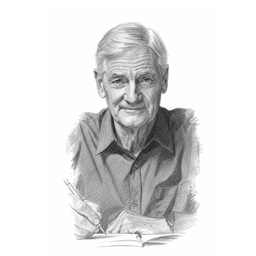
James Dyson
The British inventor who made 5,127 prototypes to revolutionize the vacuum cleaner and prove persistence pays.
New to James? Start with Invention: A Life of Learning Through Failure
James Dyson's Origin Story
Early Life
James Dyson was born on May 2, 1947, in Cromer, Norfolk, but his childhood took a dramatic turn when his father died of prostate cancer when James was just nine years old. He landed a scholarship to Gresham's School, where he discovered his talent for long-distance running—a pursuit that taught him the determination that would define his career. The boy who lost his father early learned to push through pain and keep going when others quit.
The Spark
The spark came from an unlikely source: a sawmill. In the late 1970s, Dyson noticed how industrial cyclones separated sawdust from air and had his eureka moment—why not apply this to vacuum cleaners?
First Moves
What followed was either madness or genius, depending on your perspective. Dyson built his first cyclonic vacuum prototype out of cereal packets and masking tape, then spent the next five years making 5,127 prototypes in his workshop. With no UK manufacturer willing to disrupt the profitable dust bag market, he had to take his invention to Japan, where the G-Force launched in 1983 for the equivalent of $2,000—proving that sometimes you have to go halfway around the world to prove you're not crazy.
James Dyson's Core Beliefs & Principles
James Dyson's Pivotal Decisions
Committed to spending 5 years and making 5,127 prototypes to perfect cyclonic vacuum technology, despite having no manufacturing backing
This obsessive persistence created the breakthrough that would revolutionize the vacuum industry. Most inventors would have quit after dozens of failures, but Dyson's willingness to iterate thousands of times led to the bagless technology that became his fortune.
Launched G-Force vacuum in Japan for $2,000 when no UK manufacturer would touch his product
This decision to go overseas proved the commercial viability of his technology and generated the revenue needed to eventually launch in his home market. Without Japan's willingness to pay premium prices for innovation, Dyson might never have had the capital to build his own factory.
Opened his own research centre and factory in Malmesbury rather than licensing to established manufacturers
This decision to maintain total control allowed Dyson to keep 100% ownership and preserve his vision. By refusing to sell out to big appliance companies, he built a multi-billion dollar empire on his own terms and became the UK's fifth richest person.
Invested £2 billion in developing an electric vehicle, then cancelled the project in 2019
Though the project failed, this decision demonstrated Dyson's willingness to bet big on breakthrough technology. The digital motor and battery innovations developed for the car project were repurposed into other Dyson products, showing how even 'failures' can drive innovation forward.
What NOT to Do
Losing control of his own company
Dyson lost his Ballbarrow company and patents due to poor board decisions and cash flow management. He learned the hard way to assign patents to himself rather than the company, and why maintaining control matters more than taking on investors.
£2 billion electric car miscalculation
After assembling a 400+ person team and investing £2 billion over two years, Dyson cancelled the entire electric vehicle project in 2019 because it wasn't commercially viable. Even seasoned entrepreneurs can massively misjudge new markets.
Stubborn persistence on doomed products
The ContraRotator washing machine ran from 2000 to 2005 before being discontinued as commercially unsuccessful. Sometimes knowing when to quit is as important as knowing when to persist through 5,126 failed prototypes.
James Dyson Quotes
“I made 5,127 prototypes of my vacuum before I got it right. There were 5,126 failures. But I learned from each one. That's how I came up with a solution.
“The only way to make real money is to offer the public something entirely new that has style value as well as substance and which they cannot get anywhere else
“Above all how can we avoid being duffers? It comes from working away single-mindedly at solving a problem however many setbacks befall us
“We were given two hands and a brain. You should use both at the same time
“At Dyson, we don't particularly value experience. It tells you how things should be done when we are much more interested in how things shouldn't be done
Connections
Learned From

Trial-and-error methodology - Edison's empirical approach of systematic experimentation influenced James's prototyping method of learning through iteration
The power of design thinking - Principal at Byam Shaw School of Art who inspired James to become a designer and see the world through a design lens
Integration of engineering with design - Structural engineer tutor at Royal College of Art who influenced James's transfer to industrial design and showed how engineering could be creative
Empirical approach to problem-solving - Local inventor and businessman mentor who taught hands-on experimentation over theoretical analysis and employed James early in his career
Revolutionary engineering philosophy - American engineer whose geodesic domes and 'just add lightness' motto influenced James's design philosophy of achieving more with less
Addiction to continuous improvement - Honda's relentless focus on perfecting products inspired James's approach to never settling for current versions
New product development approach - Sony founder's methodology for creating entirely new product categories influenced James's product strategy
Market research skepticism - Mini designer's philosophy that 'market research is bunk' influenced James's belief in intuition over formal research
James Dyson's Life Timeline
Born May 2 in Cromer, Norfolk
Father died of prostate cancer when James was 9; started at Gresham's School on scholarship
Left Gresham's School and started at Byam Shaw School of Art
Began studying furniture and interior design at Royal College of Art
Married Deirdre Hindmarsh
Designed the Sea Truck while still at Royal College of Art
Invented the Ballbarrow—a wheelbarrow with a ball instead of a wheel
First cyclone vacuum idea came from observing sawmill cyclone technology
Filed dual cyclone vacuum patent EP0037674
Launched G-Force cleaner in Japan for equivalent of $2,000
Licensed technology to Fantom Technologies
Won International Design Fair Prize in Japan
Opened research centre and factory in Malmesbury, Wiltshire in June
Won patent lawsuit against Hoover, awarded £4 million in damages
Launched ContraRotator washing machine
Set up James Dyson Foundation
Displayed Wrong Garden water sculpture at Chelsea Flower Show; bought Dodington Park for £15 million
Discontinued ContraRotator washing machine; Dyson cleaners became market leaders in US by value
Launched Dyson Airblade hand dryer in October
Launched Air Multiplier fan in October
Became Provost of Royal College of Art in August
Introduced 360 Eye robotic vacuum in Tokyo; announced £1.5 billion R&D investment in November
Launched Supersonic hair dryer in April; opened second R&D centre at Hullavington, Wiltshire in March
Left Royal College of Art in July; launched Dyson Institute of Engineering and Technology; announced electric vehicle project in September; spending £7 million per week on R&D
Moved company headquarters to Singapore in January; cancelled electric car project in October after £2 billion investment; bought Singapore penthouse for £43 million; donated £18.75 million to Gresham's School
Sold Singapore penthouse for £36 million
Reported to have moved personal residence back to UK
Fifth richest person in UK with £23 billion net worth; donated additional £35 million to Gresham's School
James Dyson Net Worth Over Time
Values shown in estimated modern USD equivalents
James Dyson's Legacy & Impact
Business Impact
Dyson revolutionized the vacuum industry by proving consumers would pay premium prices for superior bagless cyclonic technology, creating a new template for inventor-entrepreneurs maintaining total control. His company became the fastest-selling vacuum in UK history and market leader in the US by value, while pioneering direct-to-consumer marketing and design-integrated engineering.
Philanthropy
- James Dyson Foundation
- Dyson Institute of Engineering and Technology
Recognition
- International Design Fair Prize 1991
- Provost of Royal College of Art 2011-2017
Sources & Further Reading
- Wikipedia(website)
- Founders Podcast - #25 Against the Odds: An Autobiography by James Dyson(podcast)
- Founders Podcast - #205 James Dyson (Invention: A Life)(podcast)
- Founders Podcast - #300 James Dyson (Against the Odds)(podcast)
- Founders Podcast - #400 The Stubborn Genius of James Dyson(podcast)
- Dyson.com(website)
- Britannica(website)
- Forbes(website)