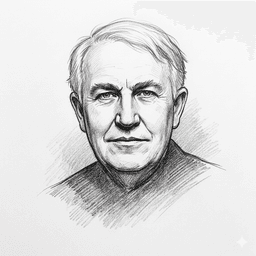
Thomas Edison
The relentless inventor who electrified the world and created the first industrial research laboratory.
New to Thomas? Start with Edison by Edmund Morris
Thomas Edison's Origin Story
Early Life
Born in 1847 in Milan, Ohio, Thomas Edison's family had fled Canada after his father got mixed up in the 1837 Rebellion. His formal education lasted all of a few months before his teacher basically gave up on him, but his mother Nancy saw something different and took over his schooling herself. By age 12, he'd developed hearing problems that would plague him for life, though he'd later claim this deafness was actually an advantage—helping him focus without distraction.
The Spark
At 15, Edison saved a 3-year-old from an oncoming train, and the grateful father taught him telegraphy as a reward. This opened up a whole new world—suddenly he had a skill that could take him anywhere the railroad went.
First Moves
Edison spent six years bouncing around as a telegraph operator, but he was always tinkering on the side. His first patent in 1869 was for an electric vote recorder that he thought would revolutionize democracy—except politicians had zero interest in faster voting. The commercial failure taught him a crucial lesson: invent for what people actually want, not what seems technically clever.
Thomas Edison's Core Beliefs & Principles
Thomas Edison's Pivotal Decisions
Abandoned his electric vote recorder after it failed commercially because politicians didn't want expedited voting
This early failure taught Edison that invention should be shaped by commercial needs, not technical cleverness - a principle that would guide all his future work and make him one of history's most commercially successful inventors.
Established Menlo Park laboratory as the world's first industrial research laboratory
Created the modern R&D model that would be copied by AT&T Bell Labs, DuPont, and Xerox PARC. This 'invention factory' approach with organized teams revolutionized how innovation happens and enabled Edison's most famous breakthroughs.
Committed to developing a complete electric lighting system, not just the bulb
While others focused on individual components, Edison envisioned the entire infrastructure - generators, wiring, meters, fixtures. This systems thinking led to Pearl Street Station in 1882, the first central power distribution system that created the foundation for our modern electric world.
Built the massive West Orange laboratory after losing some control of his electric companies
This pivot allowed Edison to diversify beyond electricity into motion pictures, storage batteries, and other innovations. The lab produced the Kinetograph camera that founded the film industry and proved Edison could reinvent himself even after major setbacks.
Founded Motion Picture Patents Company to control the film industry
Created a movie trust that guaranteed Edison $1 million annually in fees, establishing him as a major force in the early entertainment industry
What NOT to Do
Lost the War of the Currents
Edison stubbornly backed direct current (DC) over alternating current (AC), even going so far as to electrocute an elephant on film to demonstrate AC's dangers. His pride and financial investment in DC blinded him to the superior technology, costing him control of the electrical power industry to Westinghouse and Tesla.
Terrible at business control
Despite his genius for invention, Edison repeatedly lost control of his own companies. He lost majority control of Edison General Electric in the 1889 merger, and the company was renamed simply General Electric, erasing his name from his greatest business achievement.
Delayed commercialization
Edison often took too long to bring inventions to market, allowing competitors to swoop in. His phonograph took over a decade to develop commercially, and he abandoned synchronized sound-and-motion pictures due to technical difficulties, missing out on massive market opportunities.
Jumped between projects without focus
Edison invented the phonograph but lost interest for nearly a decade while competitors built their own versions. He invented incandescent bulbs and efficient generators but sold his interests early, missing out on General Electric's substantial profits. Ford observed: 'Edison is easily the world's greatest scientist. I am not sure that he is also not the world's worst businessman.'
Refused to adapt to consumer preferences
Edison insisted on producing only two-reel films when audiences wanted longer movies, and only traditional music recordings when jazz became popular, causing his companies to lose market share to competitors who gave customers what they wanted.
Thomas Edison Quotes
“Genius is 1% inspiration and 99% perspiration
“The trouble with other inventors is that they try a few things and quit. I never quit until I get what I want
“Opportunity is missed by most people because it is dressed in overalls and looks like work
“I always invent to obtain money to go on inventing
“Hell, there ain't no rules around here! We're trying to accomplish something
“The best part of any enterprise is the work itself
“Competition is essential - if you make a coalition, my usefulness as an inventor is gone
Connections
Learned From
Electrical experimentation principles - Edison read 'Experimental Researches in Electricity' which he called the decisive event of his life that inspired his electrical work
Scientific deism and rational thinking - Edison's parents owned Paine's complete works which inspired Edison's thinking throughout his life, leading to his defense of Paine's scientific deism
Telegraphy skills - The station agent taught Edison telegraphy after Edison saved his son from a train, launching Edison's career as a telegraph operator
Self-directed learning - His mother homeschooled Edison and brought him to the stage of learning things for himself after he left school
Witnessed Wallace's electrical demonstrations in 1878, which fired Edison's excitement about creating a better electric light system
Influenced

The power of practical invention and patent accumulation - Land explicitly compared his patent count to Edison's and shared Edison's belief in creating commercially viable applications from scientific discoveries

Trial-and-error methodology - Edison's empirical approach of systematic experimentation influenced James's prototyping method of learning through iteration

Received crucial early validation and encouragement for automobile experimentation. Edison approved Ford's automobile work at 1896 meeting, saying 'young man, that's the thing. You have it. Keep at it.' This endorsement from America's premier inventor gave Ford confidence to continue pursuing automotive development.
Thomas Edison's Life Timeline
Born February 11 in Milan, Ohio to Samuel and Nancy Edison.
Family moved to Port Huron, Michigan.
Left school after only a few months, began working as newsboy on trains at age 12.
Founded Grand Trunk Herald newspaper, printing it right on the train at age 13.
Saved 3-year-old from train tracks; grateful father James McKenzie taught him telegraphy in return.
Became a telegraph operator, beginning six years of traveling work.
Moved to New York City and received first patent on June 1 for electric vote recorder (which flopped commercially).
Received $40,000 from Western Union for stock ticker improvements—far more than the $5,000 he expected.
Married Mary Stilwell on Christmas Day.
Earned $30,000 for his quadruplex telegraph invention, allowing four messages on one wire.
Established Menlo Park laboratory in New Jersey, the world's first industrial research lab.
Invented the phonograph, which made him America's first civilian celebrity.
Founded Edison Electric Light Company with $30,000 in initial funding.
Successfully demonstrated practical incandescent light bulb on October 21.
Founded Edison Illuminating Company and began selling phonographs commercially for $10 each.
Pearl Street Station began operation on September 4, creating the first central power distribution system.
Wife Mary died on August 9 at just 29 years old.
Married Mina Miller on February 24, his second wife.
Built massive West Orange laboratory complex in New Jersey.
Lost majority control of Edison General Electric in corporate merger.
Talking doll venture failed when miniature phonographs broke during shipping.
Patented the Kinetograph motion picture camera.
Edison General Electric merged to form General Electric, removing his name entirely.
First met Henry Ford and encouraged his work on gasoline automobiles.
Filmed electrocution of elephant Topsy as part of campaign against AC current.
Created 'The Great Train Robbery,' one of the first narrative films that moved beyond simple skits to tell real stories.
Emerged victorious from motion picture patent wars, holding key patents for the industry.
Founded Motion Picture Patents Company to control film industry.
Partnered with Henry Ford on battery development, eventually borrowing $700,000.
Fire destroyed 10 of 18 buildings at West Orange, causing $1.5 million in damage.
Participated in annual 'Vagabond' car camping trips with Henry Ford and Harvey Firestone, which became major publicity events.
Appointed head of Naval Consulting Board during World War I.
Received Navy Distinguished Service Medal for wartime contributions.
Awarded Congressional Gold Medal.
Henry Ford donated $5 million to create Edison Institute in his honor.
Edison's companies stopped producing entertainment records after losing market share to competitors who embraced jazz and popular music.
Died October 18 at age 84 in West Orange, New Jersey; lights dimmed nationwide at his funeral.
Thomas Edison Net Worth Over Time
Values shown in estimated modern USD equivalents
Thomas Edison's Legacy & Impact
Business Impact
Edison created the world's first industrial research laboratory at Menlo Park, establishing the R&D model later copied by AT&T Bell Labs, DuPont, and Xerox PARC. His electric light system laid the foundation for the modern electric world, while his motion picture inventions founded the film industry. Edison inadvertently helped create the American entertainment industry through his motion picture work, establishing studios and filming techniques that became the foundation for Hollywood. His friendship with Henry Ford helped popularize automobile camping and road trips through their publicized 'Vagabond' adventures from 1914-1924.
Recognition
- Navy Distinguished Service Medal (1920)
- Congressional Gold Medal (1928)
- Motion Picture Patents Company control (1908)
- Pioneer of narrative filmmaking with 'The Great Train Robbery' (1904)
Sources & Further Reading
- Wikipedia(website)
- Britannica(website)
- Biography.com(website)
- National Inventors Hall of Fame(website)
- Who is Thomas Edison? || Biography of Thomas Edison(video)
- History.com(website)
- Founders Podcast - #3 The Wizard of Menlo Park: How Thomas Edison Invented The Modern the Modern World(podcast)
- Founders Podcast - #83 Thomas Edison, Nikola Tesla, George Westinghouse, and the Race to Electrify the World(podcast)
- Founders Podcast - #190 Henry Ford and Thomas Edison(podcast)
- Founders Podcast - #267 Thomas Edison(podcast)