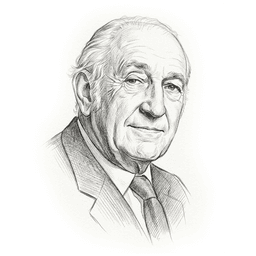
David Packard
Co-founded HP in a garage with $538, created Silicon Valley's DNA through the HP Way management philosophy.
New to David? Start with The HP Way: How Bill Hewlett and I Built Our Company
David Packard's Origin Story
Early Life
Born in Pueblo, Colorado in 1912, David Packard grew up during the Great Depression watching his father handle bankruptcy cases. The experience of seeing debt-laden companies fail while debt-free ones survived would shape his anti-debt philosophy for life. His father also taught him persistence—when young Dave struggled with a difficult horse, his father wouldn't let him quit until he mastered it.
The Spark
At Stanford, Professor Fred Terman sparked Packard's interest in electronics and encouraged him to start a company with his classmate Bill Hewlett. After a brief stint at General Electric where a manager named Mr. Boring told him electronics had no future, Packard knew he had to prove conventional wisdom wrong.
First Moves
With just $538 in capital and a Palo Alto garage, Packard and Hewlett founded HP in 1939. They flipped a coin to decide the company name (Hewlett-Packard won over Packard-Hewlett), cleverly named their first audio oscillator the 'Model 200A' to seem established, and got their big break when Walt Disney bought eight units for the movie Fantasia.
David Packard's Core Beliefs & Principles
David Packard's Pivotal Decisions
Founded HP with $538 and committed to debt-free growth model after witnessing Depression-era bankruptcies
Created foundation for 50+ years of continuous profitability. HP survived every economic downturn while leveraged competitors failed, enabling reinvestment in R&D and long-term thinking over quarterly pressures.
Chose to focus on complementary electronic instruments rather than diversifying into unrelated products
Built deep expertise and market dominance in precision instruments, creating the technical foundation that later enabled successful transition to computers. Avoided the 'indigestion' that killed other companies trying to do too much.
Implemented 10% pay cuts with 10% work reduction instead of layoffs during recession
Preserved HP's talent and culture during crisis, demonstrating the HP Way principles in action. This decision became legendary in Silicon Valley, attracting top talent who wanted to work for a company that valued employees over short-term profits.
Came out of retirement to restructure HP by eliminating bureaucratic committees and re-decentralizing decision-making
Saved HP from internal paralysis that had dropped stock to $25. The restructuring restored innovation speed and drove stock to $70 by 1993, positioning HP for the PC era and demonstrating how to scale without losing entrepreneurial agility.
What NOT to Do
Nearly missed the electronics revolution
Packard almost listened to GE's "Mr. Boring" who told him electronics had no future and to focus on heavy utility equipment instead. This shows how even great entrepreneurs can be swayed by "expert" advice that's completely wrong.
Pricing inexperience nearly killed early growth
The audio oscillator was initially priced at $54.40 when it cost more to produce, meaning they lost money on every sale. Classic rookie mistake that could have bankrupted them before they got started.
Let HP become a bureaucratic nightmare in the 1990s
The company that pioneered "management by walking around" became paralyzed by committees and centralization, causing stock to crash to $25. Packard had to come out of retirement to fix the mess he'd helped create.
David Packard Quotes
“More businesses die from indigestion than starvation
“I think many people assume wrongly that a company exists simply to make money. While this is an important result of a company's existence, we have to go deeper to find the real reason for our being.
“Customer satisfaction second to none is the only acceptable goal
“For this reason, Bill and I determined we would operate the company on a pay-as-you-go basis, financing our growth primarily out of earnings rather than borrowing money
“I found, after much trial and error, that applying steady, gentle pressure from the rear worked best
Connections
Learned From
The importance of university-industry partnerships and encouraging entrepreneurship. Terman provided customer lists, organized technical seminars, and actively encouraged the HP founding, demonstrating how academic mentors can bridge theory and practice.
Self-reliant business philosophy and the value of shared resources among entrepreneurs. Litton taught business principles, organized seminars on technical topics, and shared shop facilities, showing how peer entrepreneurs can support each other.
Influenced

Company building and legacy thinking — studied how to build enduring companies and leave money to foundations
David Packard's Life Timeline
Born September 7 in Pueblo, Colorado
Enrolled at Stanford University
Graduated Stanford with BA in electrical engineering
First official business meeting with Bill Hewlett to discuss founding a company
Earned MS in electrical engineering from Stanford and married Lucile Salter
Founded Hewlett-Packard Company with Bill Hewlett using $538 initial investment
Achieved first full year sales of $5,369 with $1,563 profit, making HP profitable from day one
Grew HP to over 200 employees and $1 million in annual sales during WWII
Incorporated HP with Packard becoming the company's first president
Bought a cattle ranch and personally built over 20 miles of roads on the property
Took HP public, expanding access to capital for growth
Established the David and Lucile Packard Foundation for philanthropy
Became CEO and chairman of HP as the company reached $125 million in sales
Appointed US Deputy Secretary of Defense under President Nixon
Implemented 10% pay cut with 10% work reduction instead of layoffs during recession
Resigned from Defense Department to return to HP
Returned to HP as chairman to guide the company's continued growth
Opened Monterey Bay Aquarium after donating $55 million for its construction
Registered HP.com domain on March 3, making HP an early adopter of internet technology
Donated $40 million to create the Lucile Packard Children's Hospital
After Lucile's death, established Monterey Bay Aquarium Research Institute with $13 million donation
Received Presidential Medal of Freedom for contributions to technology and public service
HP garage declared California historical landmark as 'birthplace of Silicon Valley'
HP faced major crisis as stock fell to $25 due to bureaucracy and committee paralysis
HP stock rebounded to $70 after restructuring, Packard retired from active management
Donated $77 million to Stanford with Hewlett as HP reached $25 billion in total sales
Published autobiography 'The HP Way' documenting management philosophy
Died March 26 at age 83 in Stanford, California, leaving $4-5.6 billion to charity
David Packard Net Worth Over Time
Values shown in estimated modern USD equivalents
David Packard's Legacy & Impact
Business Impact
Co-created the Silicon Valley ecosystem and pioneered the HP Way management philosophy emphasizing employee respect, decentralization, and customer obsession over profits. His garage startup became the template for tech entrepreneurship, directly influencing Steve Jobs and spawning dozens of successful companies founded by former HP employees.
Philanthropy
- David and Lucile Packard Foundation ($8+ billion in current assets)
- Monterey Bay Aquarium ($55 million)
- Monterey Bay Aquarium Research Institute ($13 million)
- Lucile Packard Children's Hospital ($40 million)
- Stanford University ($77 million with Hewlett)
Recognition
- Presidential Medal of Freedom (1988)
- HP garage declared California historical landmark as 'birthplace of Silicon Valley' (1989)
Sources & Further Reading
- Founders Podcast - #291 David Packard (Founder of HP)(podcast)
- Founders Podcast - #29 The HP Way: How Bill Hewlett and I Built Our Company(podcast)
- Wikipedia(website)
- MBARI(website)
- Packard.org(website)
- Britannica(website)
- EBSCO(website)
- Stanford Engineering(article)
- Celebrity Net Worth(article)