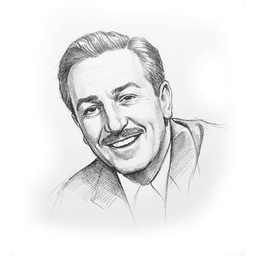
Walt Disney
The farm boy who turned a mouse into a multimedia empire and invented the modern theme park
New to Walt? Start with Walt Disney: The Triumph of the American Imagination by Deckle Edge
Walt Disney's Origin Story
Early Life
Walter Elias Disney was born December 5, 1901, in Chicago to Flora and Elias Disney. His father Elias was harsh and didn't believe children should have toys, setting the stage for Walt's later obsession with creating joy for families. By age 9, Walt was delivering newspapers and waking at 3:30 AM - early training in the work ethic that would define his life.
The Spark
Walt discovered animation through a handbook he found in the Kansas City Public Library and began practicing by copying cartoons from newspapers. This self-taught foundation would launch an empire. Disney's artistic calling emerged early despite ridicule - classmates mocked drawing as 'sissy' work, and his teacher considered him the second dumbest student in class because he spent all his time drawing instead of paying attention to lessons. He would decorate textbook margins with pictures and entertain classmates by flipping through them to create simple animations.
First Moves
In 1920, Walt and Ub Iwerks started Iwerks-Disney Commercial Artists, which lasted exactly one month due to lack of customers. Undeterred, Walt established Laugh-O-Gram Studio in 1921, but it went bankrupt in 1923 when distributors stiffed him. With $40 in his pocket, he headed to Hollywood to try again. After WWI service as a Red Cross ambulance driver (where he met fellow driver Ray Kroc, future McDonald's founder), Disney worked various jobs including filming weddings and funerals for $10-15 each when his first animation company failed. He often survived on canned beans and could only afford to shower once a week at the YMCA.
Walt Disney's Core Beliefs & Principles
Walt Disney's Pivotal Decisions
After losing Oswald the Lucky Rabbit and his entire animation staff to distributor Charles Mintz, Disney vowed 'Never again will I work for somebody else' and created Mickey Mouse with Ub Iwerks, insisting on owning all trademarks and copyrights.
This betrayal fundamentally changed Disney's approach to business - he would control his intellectual property from then on. Mickey Mouse became the foundation of his empire, and the ownership principle became core to Disney's massive success and wealth accumulation.
Decided to create the first feature-length animated film with Snow White and the Seven Dwarfs, spending three times the budget ($1.5 million) despite industry skepticism about audiences watching a 90-minute cartoon.
Proved animation could work as feature films and established Disney as a major studio. Snow White grossed $6.5 million and provided the financial foundation for Disney's expansion into multiple films and eventually theme parks.
Mortgaged everything - borrowed against his life insurance policy and sold his vacation home - to finance the $17 million Disneyland project when no one believed in theme parks.
Created the modern theme park industry and transformed Disney from a film studio into a diversified entertainment empire. Company revenues exploded from $6 million to $70 million, and Disneyland became a template copied worldwide.
Partnered with ABC television to create the 'Disneyland' TV show, using the new medium to promote and help finance his theme park when traditional funding sources refused.
ABC invested $4.5 million in Disneyland in exchange for the show. This pioneered the concept of using one entertainment medium to promote another, creating the integrated media strategy that modern entertainment companies still use today.
What NOT to Do
Catastrophic lack of control over intellectual property
Disney lost his entire animation staff and the rights to Oswald the Lucky Rabbit to distributor Charles Mintz in 1928, a devastating blow that taught him the hard lesson of maintaining ownership and control over his creations.
Extreme perfectionism leading to mental breakdowns
Disney's relentless pursuit of perfection and overwork caused multiple nervous breakdowns, including in 1931 and 1948, showing how his inability to delegate and accept 'good enough' nearly destroyed his health and relationships.
Poor labor relations and authoritarian management style
The devastating 1941 animators' strike that reduced his staff from 1,600 to 600 revealed Disney's failure to understand his employees' needs and his resistance to sharing creative and financial control, permanently damaging studio morale.
Inability to delegate creative authority
Disney's need for total control extended to knowing the exact inventory of light bulbs in his studio and memorizing the heights of every building in Disneyland. His refusal to delegate was the most common complaint from producers, writers, directors, and management who worked under him.
Terrible financial estimations
Disney consistently underestimated costs by massive margins - he thought Disneyland would cost $1.5 million but it cost $17 million, a pattern repeated throughout his career with films and projects regularly exceeding budgets by 300-400%.
Walt Disney Quotes
“Never again will I work for somebody else
“I've always been bored with just making money. I've wanted to do things. I wanted to build things, to get something going
“The way I see it, Disneyland will never be finished. It's something we can keep developing and adding to
“We create happiness
“If we lose the detail, we lose it all
“You can't top pigs with pigs
Connections
Learned From

Visited Ford's Greenfield Village which inspired Disney's approach to themed environments and attention to authentic historical detail in park design
Advised Disney to own every picture he makes and patterned Mickey Mouse's behavior after Chaplin's comedy style
Disney studied Terry's Aesop's Fables as a model for Laugh-O-Grams
Learned technique of combining live action with animated characters from Fleischer's 1917 innovation, which Disney adapted for his Alice cartoons
Influenced

Met during Red Cross ambulance training in WWI where both lied about their age to enlist. Disney's influence on Kroc's entrepreneurial vision and attention to detail in creating experiences.
Walt Disney's Life Timeline
Born December 5 in Chicago to Flora and Elias Disney
Family moved to farm in Marceline, Missouri, which later inspired Main Street USA
Started delivering newspapers at age 9, waking at 3:30 AM daily
Family moved to Kansas City, Missouri where Walt discovered animation
Family moved back to Chicago, Walt enrolled at McKinley High School
Forged birth certificate to join Red Cross as ambulance driver in France during WWI
Served as Red Cross ambulance driver in France alongside Ray Kroc (future McDonald's founder)
Returned to Kansas City and worked as apprentice artist
Worked various jobs including filming weddings/funerals for $10-15, often surviving on canned beans
Started Iwerks-Disney Commercial Artists with Ub Iwerks, lasted one month
Established Laugh-O-Gram Studio, raised $15,000 for incorporation
Laugh-O-Gram Studio went bankrupt after receiving only $100 deposit for six cartoons, moved to Hollywood with $40
Formed Disney Brothers Studio with brother Roy in October
Married studio employee Lillian Bounds on July 13
Established first official Walt Disney Studio at 2725 Hyperion Avenue
Lost Oswald the Lucky Rabbit and entire animation staff to distributor Charles Mintz
Created Mickey Mouse with Ub Iwerks and released Steamboat Willie, first synchronized sound cartoon
Suffered nervous breakdown from overwork and financial pressure
Released Flowers and Trees, first cartoon in full-color Technicolor
Released The Three Little Pigs, major hit that helped studio survive Depression
Refused to give television rights to United Artists when only 2,000 TV sets existed worldwide
Released Snow White and the Seven Dwarfs, first feature-length animated film, cost $1.5 million
Mother Flora died November 26 from carbon monoxide poisoning from defective heater Walt had installed
Snow White grossed $6.5 million by May, proving feature animation viable
Company went public raising $3.5 million and moved to new Burbank studio
Released Pinocchio and Fantasia, both performed poorly due to European war cutting markets
Five-week animators' strike reduced staff from 1,600 to 600, U.S. Army took over studio for 8 months during WWII
Company owed $4 million to Bank of America at lowest point
Began period of depression, spending time building model trains while disengaged from studio work
Suffered another nervous breakdown during depression period
Released Cinderella for $2.2 million, earned $8 million in first year, saving the company
Received zoning permission for theme park in Burbank, began serious Disneyland planning
Wrote first memo for 'Mickey Mouse Park' after visiting railroad fair and Henry Ford's Greenfield Village
Created revolutionary ABC television deal to finance Disneyland after CBS and NBC refused
Construction of Disneyland began in July after securing $17 million financing
Launched weekly 'Disneyland' TV show, creating 8-month promotional campaign before park opening
Disneyland opened July 17 with disastrous opening day but became massive success
Company gross jumped from $6 million to $27 million in first year of Disneyland
Company gross reached $70 million by end of decade
Paid off Bank of America loan after 22 years on April 25
Released Mary Poppins, major live-action success
Announced Disney World development in Florida
Died December 15 of lung cancer at age 65, heavy smoker throughout life
Walt Disney Net Worth Over Time
Values shown in estimated modern USD equivalents
Walt Disney's Legacy & Impact
Business Impact
Disney revolutionized the entertainment industry by creating the first synchronized sound cartoon, pioneering feature-length animation, and inventing the modern theme park concept with immersive themed environments. His innovations in merchandising, transmedia storytelling, and customer experience established templates still used by entertainment companies today. Disney pioneered the modern multimedia entertainment conglomerate and proved television could be promotional ally rather than competitive threat. His theme park innovations created entirely new industry categories and demonstrated how personal taste could scale to mass market appeal.
Recognition
- Holds record for most Academy Awards won by an individual (22) and nominations (59)
- Created the first synchronized sound cartoon (Steamboat Willie, 1928)
- Built world's first modern theme park that changed global entertainment industry
- Pioneered multimedia entertainment empire spanning films, TV, theme parks, and merchandise
Sources & Further Reading
- Wikipedia(website)
- Britannica(website)
- Walt Disney Archives(website)
- PBS(website)
- Founders Podcast - #2 Walt Disney(podcast)
- Founders Podcast - #39 Walt Disney: An American Original(podcast)
- Founders Podcast - #158 Walt Disney (Disneyland)(podcast)
- Founders Podcast - #310 Walt Disney and Picasso(podcast)
- Founders Podcast - #346 How Walt Disney Built Himself(podcast)
- Founders Podcast - #347 How Walt Disney Built His Greatest Creation: Disneyland(podcast)