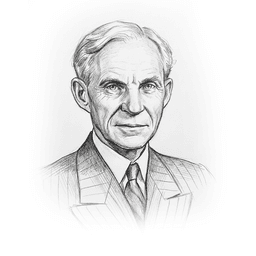
Henry Ford
The farm boy who mass-produced the modern world and made cars affordable for everyone.
New to Henry? Start with My Life and Work by Henry Ford
Henry Ford's Origin Story
Early Life
Henry Ford was born July 30, 1863, on a prosperous farm in Springwells Township, Michigan, where his father William gave him a pocket watch at age 12 that sparked his fascination with mechanics. His world shifted dramatically in 1876 when his mother Mary died, leaving young Henry feeling disconnected from farm life. By 16, he'd had enough of rural living and bolted for Detroit to work in machine shops, despite having only an eighth-grade education.
The Spark
The real catalyst came in 1896 when Ford met his hero Thomas Edison, who looked at Ford's automobile experiments and declared: 'Young man, that's the thing. You have it. Keep at it.' Edison's blessing gave Ford the confidence to pursue what everyone else thought was a crazy hobby.
First Moves
Ford's first venture, the Detroit Automobile Company founded in 1899, was a spectacular flop—dissolved by January 1901 due to high prices and shoddy quality. He tried again with the Henry Ford Company in 1902, but conflicts led him to walk away (it later became Cadillac). Third time proved the charm when he incorporated Ford Motor Company on June 16, 1903, with just $28,000 in capital and a stubborn belief that he could build cars for the masses.
Henry Ford's Core Beliefs & Principles
Henry Ford's Pivotal Decisions
Introduced the Model T and committed to mass production of a single model
Revolutionized the automobile industry by making cars affordable for ordinary Americans. Reduced price from $825 to $360 while producing over 15 million units. By 1918, half of all cars in the US were Model Ts, transforming America into a mobile society.
Introduced the moving assembly line at Highland Park
Cut Model T production time from 12 hours to 2.5 hours, enabling unprecedented scale and efficiency. This manufacturing breakthrough became the foundation of modern industrial production and made Ford the template for 20th-century mass manufacturing.
Announced the $5 daily wage, more than doubling worker pay
Created the modern industrial workforce by turning factory workers into consumers who could afford the products they made. Reduced turnover, increased productivity, and established the principle that high wages and low prices could coexist profitably.
Bought out all minority stockholders for $105 million to own 100% of Ford Motor Company
Gained complete control to implement his vision without investor interference, but also isolated the company from outside capital and fresh perspectives. This decision shaped Ford's insular culture for decades and contributed to later competitive struggles.
What NOT to Do
Dangerous obsession with control
Ford's need to own everything 100% led him to buy out all minority stockholders for over $100 million in 1919, then violently resist unionization. This controlling nature created the brutal 1937 'Battle of the Overpass' and damaged his reputation when he should have been building partnerships.
Catastrophic anti-Semitism
Ford published anti-Semitic content in The Dearborn Independent for nearly a decade and received Nazi Germany's Grand Cross of the German Eagle in 1938. This wasn't just morally reprehensible—it directly influenced Nazi ideology and overshadowed his business achievements.
Stubborn resistance to innovation
Ford clung to the Model T for 19 years while competitors innovated, then was late adopting hydraulic brakes and all-metal roofs until the mid-1930s. His 'not invented here' syndrome cost Ford its market leadership to General Motors and Chrysler.
Henry Ford Quotes
“Whether you think you can, or you think you can't—you're right
“If I had asked people what they wanted, they would have said faster horses
“Anyone who stops learning is old, whether at twenty or eighty. Anyone who keeps learning stays young
“Failure is only the opportunity more intelligently to begin again
“The only real mistake is the one from which we learn nothing
Connections
Learned From

Received crucial early validation and encouragement for automobile experimentation. Edison approved Ford's automobile work at 1896 meeting, saying 'young man, that's the thing. You have it. Keep at it.' This endorsement from America's premier inventor gave Ford confidence to continue pursuing automotive development.
Learned mechanical curiosity and practical skills from father who owned prosperous Dearborn farm. Father gave Henry pocket watch at age 12, sparking lifelong fascination with mechanical devices and precision engineering.
Influenced

Hiring and personally training untrained talent rather than relying on established experts - Land adopted Ford's approach of bringing in fresh minds and molding them to his methods

Visited Ford's Greenfield Village which inspired Disney's approach to themed environments and attention to authentic historical detail in park design
Henry Ford's Life Timeline
Born July 30 in Springwells Township, Michigan to William and Mary Ford on a prosperous farm.
Mother Mary Ford died, leaving Henry feeling disconnected from farm life.
Left home at 16 to work in Detroit machine shops, abandoning farm life for the industrial city.
Married Clara Jane Bryant on April 11, gaining a supportive partner who would back his automobile dreams.
Became engineer at Edison Illuminating Company, providing steady income while he tinkered with automobiles.
Son Edsel Ford born November 6; Henry promoted to chief engineer at Edison, giving him more time and resources for experiments.
Completed first automobile 'Quadricycle' on June 4 and met Thomas Edison, who encouraged his automotive pursuits.
Founded Detroit Automobile Company August 5, his first attempt at commercial automobile manufacturing.
Detroit Automobile Company dissolved in January due to high prices and poor quality vehicles.
Ford Motor Company incorporated June 16 with $28,000 capital, Ford's third and finally successful automotive venture.
Model T introduced October 1, initially priced at $825—the car that would transform America.
Awarded patent for transmission mechanism, one of 161 patents Ford would eventually receive.
Introduced moving assembly line, reducing Model T production time from 12 hours to 2.5 hours.
Announced $5 daily wage January 5, more than doubling worker pay and shocking the industrial world.
Son Edsel became president December 30, though Henry retained ultimate control of the company.
Bought out all minority stockholders for $105,820,894, achieving 100% ownership of Ford Motor Company.
Purchased Lincoln Motor Company, expanding into the luxury car market.
Introduced five-day, 40-hour work week, another revolutionary labor practice.
Final Model T produced after 15,007,034 units; Model A introduced as replacement.
Battle of the Overpass with UAW occurred May 26, a violent clash that damaged Ford's reputation.
Signed first UAW contract in June after years of resisting unionization.
Edsel Ford died May 26; Henry resumed presidency at age 79, showing signs of mental decline.
Grandson Henry Ford II took control in September as Henry's health and mental capacity deteriorated.
Died April 7 at age 83 from cerebral hemorrhage at Fair Lane estate, leaving most wealth to Ford Foundation.
Henry Ford Net Worth Over Time
Values shown in estimated modern USD equivalents
Henry Ford's Legacy & Impact
Business Impact
Ford revolutionized manufacturing through the moving assembly line and made automobiles accessible to the middle class by dramatically reducing production costs. His introduction of the $5 daily wage and 40-hour work week established modern industrial employment practices that influenced labor standards worldwide.
Philanthropy
- Ford Foundation
Recognition
- Grand Cross of German Eagle from Nazi Germany in 1938
- 161 US patents
Sources & Further Reading
- Wikipedia(website)
- History.com(website)
- PBS(website)
- Ford(website)
- Biography.com(website)
- Britannica(website)
- Founders Podcast - #9 I Invented the Modern Age: The Rise of Henry Ford(podcast)
- Founders Podcast - #26 My Life and Work: The Autobiography of Henry Ford(podcast)
- Founders Podcast - #80 Henry Ford (Today and Tomorrow)(podcast)
- Founders Podcast - #118 Forty Years With Henry Ford(podcast)
- Founders Podcast - #190 Henry Ford and Thomas Edison(podcast)
- Founders Podcast - #266 Henry Ford's Autobiography(podcast)
- Henry Ford: The Good, Bad and Ugly | STUFF YOU SHOULD KNOW(video)